

Introducing solid foods is a key milestone in a child’s development. Faced with two popular approaches — Baby-Led Weaning (BLW) and traditional spoon-feeding with purées — many parents feel unsure, or even anxious.
Should you let your baby self-feed from 6 months? Or introduce solids spoon by spoon? The truth is more nuanced than a binary choice. This article is here to guide you — without pressure or dogma — towards an informed, personalized approach that suits both your baby… and you.

What Is Baby-Led Weaning (BLW)?
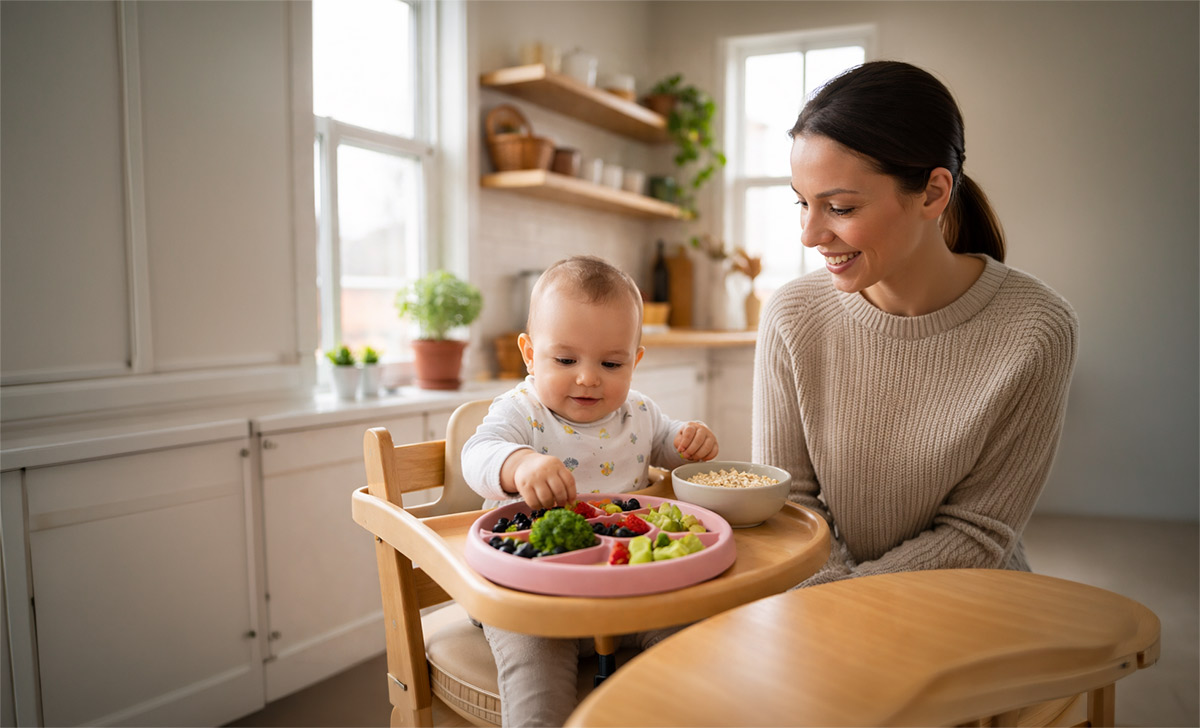
BLW involves offering soft, graspable pieces of food from the start of complementary feeding (around 6 months), skipping the purée stage. Babies feed themselves with their hands, at their own pace, in complete autonomy.
Scientifically observed benefits:
- Development of fine motor skills and hand-eye coordination
- Early awareness of satiety cues
- Reduced risk of food neophobia (fear of new foods)
- Inclusion in family meals without the need for separate “baby food”
However, BLW requires:
- Constant supervision to avoid choking hazards
- Proper seating posture (baby upright and well-supported)
- Readiness in terms of motor development (stable sitting, fading of tongue-thrust reflex)

And What About Purées?
The traditional method involves starting with smooth purées, then mashed textures, then gradually introducing small pieces. This approach has been validated for decades and remains perfectly suitable for many babies.
Advantages:
- Reassuring for parents concerned about choking
- Easier control over how much the baby eats
- Simplifies care in daycare settings, with nannies, or in large families
To avoid:
- Overextending the purée phase, which may delay the development of chewing
- Pressuring the baby to finish meals, which can harm their ability to self-regulate hunger
What Studies Say
Comparative studies have not declared a single superior method. What truly matters is:
- Introducing allergenic foods (egg, peanut, fish…) before 12 months reduces the risk of allergies
- A wide variety of foods, textures, and colors fosters curiosity and food acceptance
- The mealtime environment directly impacts the child’s relationship with food
- Respecting hunger and fullness cues supports healthy emotional and eating regulation

Most Important: Staying Relaxed
The goal is not to follow a “perfect” method, but to support your child with kindness throughout this new learning phase. A combined approach (purées + finger foods) is entirely possible — and even encouraged by many pediatricians for a smooth transition.
- The right pace is your baby’s pace
- The right choice is the one that makes you feel confident
- The right method is the one that suits your lifestyle, your culture, and your child

Conclusion
There’s no one “right” answer — just many beautiful paths toward healthy, joyful eating.
Whether you choose BLW, traditional purées, or a mix of both, what matters most is feeding your baby with love, trust… and a little patience for the mess.
Complementary feeding is a sensory, motor, and emotional journey — not a competition. Let your baby — and your instincts — be your guide.
Sources
- Rapley G. & Murkett T. (2008). Baby-Led Weaning: The Essential Guide
- French Society of Pediatrics – 2021 Guidelines on Complementary Feeding
- WHO – Feeding and Nutrition of Infants and Young Children
- Perkin M.R. et al. (2016). Randomized Trial of Allergenic Food Introduction in Breast-Fed Infants
- Ferrer-Miralles N. et al. (2021). BLW vs. Traditional Weaning: Comparative Study – Nutrients Journal